Choosing the right payment provider is one of the most consequential decisions a UK small business can make. Get it wrong and you end up locked into high rates, clunky hardware, or a support team that goes quiet when you need them most. Get it right and taking card payments becomes the least of your worries.
Flatpay and SumUp are two of the most talked-about options for UK merchants in 2026. SumUp is a well-established European fintech with over a decade in the market, a free business bank account, and a broad ecosystem of digital tools. Flatpay is the newer challenger, founded in Denmark in 2022, built on a single proposition: one flat rate, no monthly fees, and a human being to install everything for you.
This guide breaks down every meaningful difference between the two: fees, hardware, software, security, regulation, and who each platform genuinely suits. Nothing is invented here. Every fee and feature comes directly from the providers’ own UK websites.
Flatpay vs SumUp: At a Glance
| Feature | Flatpay | SumUp |
|---|
| Founded | 2022, Copenhagen | 2012, Berlin/London |
| UK merchants | Part of 70,000+ Europe-wide | Part of 4m+ worldwide |
| FCA regulated | Not FCA authorised — verify at register.fca.org.uk | Yes — FRN 900700 |
| Pricing model | Flat rate, no monthly fee | Pay-as-you-go or monthly plan |
| Entry in-person rate | 1.49% (Terminal product) | 1.69% (pay-as-you-go) |
| Monthly plan rate | No monthly fee option | 0.99% with Payments Plus (£19/mo) |
| Setup fee | £0 (Terminal) / up to £2,495 (POS Premium) | £0 always |
| Business bank account | No | Yes — free with Mastercard |
| Cash advance | Yes — Flatpay Capital (via Liberis) | Yes — SumUp Cash Advance |
| On-site installation | Yes — included | No — self-install |
| 24/7 support | Yes — phone & email | 7 days/week in-app |
| Hardware warranty | — | 1-year warranty |
| Chargeback fee | — | £10 per dispute |
| Daily payouts | Yes | Yes (via Business Account) |
About Flatpay
Flatpay was founded in 2022 in Copenhagen, Denmark by three digital payment specialists: Peter Lüth, Sander Janca-Jensen, and Rasmus Busk. Their starting point was a frustration familiar to any small business owner who has tried to decipher a payment provider’s invoice: why is this so complicated?
The answer they built was simple: one flat rate for every card type, no monthly fee, a real person who comes to install everything, and a support team available around the clock. Since launch, Flatpay has expanded into Finland, Germany, Italy, France, the Netherlands, and the UK, where it is based at Soho Works, 2 Television Centre, White City, London.
As of August 2026, Flatpay has over 70,000 merchants across Europe and more than 1,300 employees. The company is backed by Seed Capital, Dawn Capital, AVP, and Smash Capital. It is a payment processing company only — it does not offer business bank accounts, invoicing tools, or multi-currency wallets.
Flatpay ApS is incorporated in Denmark and operates in the UK through a registered Companies House establishment (BR027644). It does not hold direct FCA authorisation as an Electronic Money Institution (EMI) or Payment Institution (PI), meaning it may not be subject to the same regulatory protections as FCA-authorised providers.
About SumUp
SumUp was founded in 2012 and is one of Europe’s most established payment technology companies. SumUp Payments Limited is authorised by the Financial Conduct Authority (FCA) under the Electronic Money Regulations 2011, with registered reference number 900700. This means it operates as an authorised electronic money institution in the UK — not a bank, but a regulated entity that issues e-money accounts and provides payment services.
As of August 2026, SumUp serves over 4 million merchants worldwide and processes billions of pounds every month. Beyond card readers, SumUp offers a free business bank account with a Mastercard, invoicing, payment links, an online store, appointment bookings, loyalty programmes, a merchant cash advance, and Making Tax Digital support in partnership with Sage.
Customer funds held in the SumUp Business Account are safeguarded in segregated accounts but are not FSCS-protected, as SumUp is an EMI rather than a bank.
Fees & Pricing: A Direct Comparison
This is where the decision gets interesting — and where many comparison sites get it wrong by presenting only the headline rate without context.
| Payment Type | Flatpay | SumUp |
|---|
| In-person (Terminal) | 1.49% — all cards | 1.69% (pay-as-you-go) |
| In-person (POS products) | 1.69% — all cards | 1.69% (pay-as-you-go) |
| With monthly plan | No plan — flat rate only | 0.99% + £19/month (Payments Plus) |
| Online payments | Not offered | 2.50% |
| AMEX / all card types | Same flat rate — no surcharge | 1.69% in-person |
| Monthly fee | £0 | £0 (free) or £19 (Payments Plus) |
| Custom pricing threshold | £200,000+ annual turnover | £10,000+/month turnover |
| Chargeback fee | — | £10 per dispute (non-refundable) |
Understanding the Numbers
Flatpay’s Terminal product charges 1.49% per transaction with no monthly fee — the lowest standard in-person rate of the two. But it applies specifically to the standalone Terminal. The mPOS, POS Pro, and POS Premium all charge 1.69% — the same as SumUp’s pay-as-you-go rate.
SumUp’s Payments Plus plan costs £19 per month and drops the in-person rate to 0.99% for domestic consumer cards. For any business turning over £3,000 or more per month in card payments, the maths favours Payments Plus — at £3,000 the monthly saving (0.70% x £3,000 = £21) already outweighs the £19 monthly cost.
On chargebacks: SumUp charges a non-refundable £10 fee per dispute, deducted whether or not the decision goes in your favour. Flatpay does not publish a chargeback fee on its UK website.
Which Is Cheaper in Practice?
- Under £2,000/month: Flatpay’s 1.49% Terminal rate is cheaper — no monthly fee to absorb.
- £3,000–£10,000/month: SumUp Payments Plus at 0.99% + £19/month is likely cheaper overall for domestic consumer card payments.
- Over £10,000/month: Both providers offer custom pricing. SumUp’s Tailored plan is available from £10,000/month. Flatpay’s custom rate activates at £200,000 annually (around £16,667/month).
Always confirm current pricing directly with each provider before signing up.
Hardware: What You Get and What It Costs
| Device | Flatpay | SumUp |
|---|
| Entry card reader | Payment Terminal — £0 setup, 1.49% | Solo Lite — £25 (pairs with phone) |
| Standalone terminal | Payment Terminal (PAX A920 Pro) — standalone | Solo — £79 |
| Handheld POS | mPOS (PAX A920 2GB Pro) — £995 setup | Terminal — £135 |
| Countertop POS | POS Pro (Lenovo Tab + PAX) — £1,495 setup | Register — £399 |
| Premium POS | POS Premium (CPOS X5) — £2,495 setup | Register kits up to £649 |
| No-hardware option | — | Tap to Pay — £0, uses your phone |
| Built-in receipt printer | Yes — all Flatpay terminals | Terminal only (£135) |
| On-site installation | Yes — included with every product | No — self-install from box |
| Hardware warranty | — | 1 year on all hardware |
| Money-back guarantee | — | 30-day money-back on all hardware |
Flatpay Hardware
Flatpay’s hardware range is built around the PAX A920 Pro — a robust Android terminal with NFC, WiFi, and 4G connectivity with a built-in SIM card and a built-in receipt printer. The key differentiator is Flatpay’s on-site installation: every product includes a personal onboarding session, a tailored offer, and a specialist who configures and installs everything at your premises.
The trade-off is upfront cost. While the Terminal has no setup fee, the mPOS costs £995 to onboard, POS Pro costs £1,495, and POS Premium costs £2,495. These cover hardware, installation, configuration, and training.
SumUp Hardware
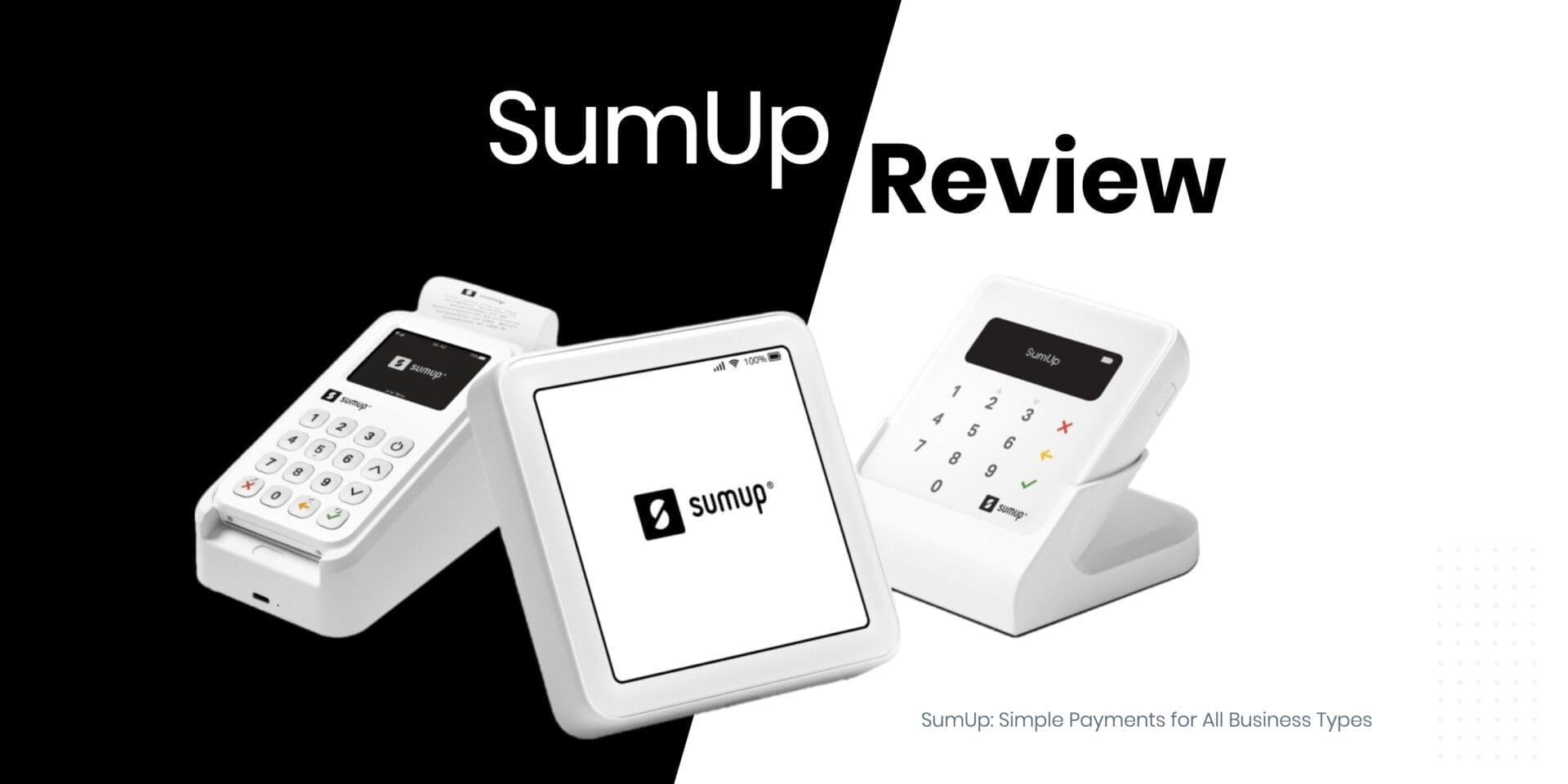
SumUp’s hardware range is more accessible at the entry level. The Solo Lite at £25 pairs with your phone. The Solo at £79 is standalone. The Terminal at £135 is handheld with a built-in printer. The Register at £399 is a dual-screen countertop system. All hardware ships in 2–3 business days, carries a 1-year warranty, and includes a 30-day money-back guarantee. SumUp also offers Tap to Pay — no hardware needed.
Software & Features
| Feature | Flatpay | SumUp |
|---|
| Free POS app | Yes — included | Yes — free plan |
| Invoicing | Not offered | Yes — free basic; £8/mo for Plus |
| Payment links | Not offered | Yes — free |
| Online store | Not offered | Yes — available |
| Bookings / appointments | Not offered | Yes — SumUp Bookings |
| Loyalty programme | Not offered | Yes — built into POS |
| Gift cards | Not offered | Yes |
| Table management | Yes — mPOS and POS Pro+ | Yes — POS Plus (£39/mo) |
| Kitchen printing | Optional on POS Pro/Premium | Optional with POS Plus |
| Accounting integration | Yes — via Merchant Portal | Yes — via POS Plus |
| Making Tax Digital | — | Yes — powered by Sage |
| Business bank account | No | Yes — free, with Mastercard |
Flatpay Software
Flatpay’s software covers sales recording, refunds, Z-reports, X-reports, and transaction history. The mPOS and POS products add table management, saved orders, Dine-in/Dine-out mode, discounts, split orders, and kitchen printing. All merchants access the Flatpay Merchant Portal with real-time reporting and automatic accounting uploads.
Flatpay has no invoicing, payment links, online store, loyalty programme, gift cards, or appointment booking system. It is built for businesses that primarily need in-person card acceptance.
SumUp Software
Every SumUp account includes the free POS app, Tap to Pay, Payment Links, basic invoicing, and reporting. The Business Account integrates directly with payment tools, with next-day availability even on weekends and bank holidays. Making Tax Digital support, in partnership with Sage, is available within the Business Account dashboard — relevant for self-employed merchants filing quarterly updates to HMRC under the MTD framework rolled out in April 2026.
POS Plus at £39/month adds floor plan management, barcode scanning, and accounting integrations. Invoices Plus at £8/month removes invoicing limits and adds multi-currency support. Business Account Plus at £15/month adds extra cards and balances.
Business Funding
Flatpay Capital
Flatpay Capital is a merchant cash advance for existing Flatpay merchants, provided by Flatpay Financial Services A/S and powered by Liberis. Offers are pre-approved based on card sales history. Repayment is automatic, deducted as a percentage of daily card sales. Flatpay states 60% of merchants received funding within 3 business days in September 2025. All applications are subject to underwriting. A minimum monthly repayment applies.
SumUp Cash Advance
SumUp Cash Advance is invite-only, based on SumUp card sales history. A fixed fee is charged upfront rather than interest. Funds are deposited within 2 working days. Repayment is deducted automatically from daily card sales, with no deduction on days without sales. Early repayment is allowed at no extra charge.
Neither Flatpay Capital nor SumUp Cash Advance is a traditional regulated loan product. Both are commercial cash advances. Always read full terms before accepting any offer.
Security & Regulation
| Security Feature | Flatpay | SumUp |
|---|
| FCA regulated | Not FCA authorised — verify at register.fca.org.uk | Yes — FRN 900700 |
| Entity type | Danish company (Flatpay ApS) | UK EMI (SumUp Payments Ltd) |
| Fund safeguarding | — | Yes — segregated accounts |
| FSCS protection | — | No — EMI, not a bank |
| PCI DSS | Yes — all card schemes require it | Yes — confirmed |
| 3D Secure | — | Yes — on business account card |
| Biometric login | — | Yes — fingerprint/face ID |
| Chargeback fee | — | £10 per dispute (non-refundable) |
SumUp: Regulatory Clarity
SumUp Payments Limited is FCA authorised under the Electronic Money Regulations 2011 (FRN 900700). This is clearly stated in the footer of every page on its website. As an EMI, SumUp safeguards customer funds in segregated accounts separate from its own capital. Funds are not lent or reinvested. They are not FSCS-protected, but the EMR safeguarding requirement provides strong ring-fencing. SumUp charges a £10 non-refundable fee per chargeback dispute.
Flatpay: Regulatory Position
Flatpay ApS is a Danish company registered at Companies House as a UK branch (BR027644). It does not appear to hold FCA authorisation. Any business that requires regulatory certainty should search the FCA Financial Services Register at register.fca.org.uk before signing up.
Who Should Choose Flatpay?
Flatpay is the right choice for a UK business that:
- Primarily takes in-person card payments and does not need invoicing, online selling, or payment links
- Wants the lowest possible transaction rate without a monthly subscription — 1.49% on the Terminal is among the most competitive flat rates in the UK market
- Values hands-on support: a specialist who installs and configures everything, reducing the burden on non-technical staff
- Runs a hospitality or food service business and needs table management, Dine-in/Dine-out, and kitchen printing on a handheld device
- Has high-volume in-person sales and can negotiate custom rates above £200,000 annual turnover
Flatpay is less suitable if:
- You need invoicing, payment links, an online store, or appointment bookings
- You want Tap to Pay with no hardware investment
- You need confirmed FCA authorisation from your payment provider
- You process high volumes and want a lower rate from a monthly plan
Who Should Choose SumUp?
SumUp is the right choice for a UK business that:
- Wants an all-in-one platform: card reader, business bank account, invoicing, and online store from one provider
- Is a sole trader, freelancer, or micro-business looking for the easiest and cheapest entry point — Tap to Pay costs nothing
- Processes £3,000 or more per month and wants to reduce its transaction rate to 0.99% via Payments Plus
- Needs Making Tax Digital compliance tools built into its financial dashboard
- Runs a beauty, health, or service business and wants appointment bookings, loyalty tools, and automated reminders
- Values clear FCA regulation and a well-established UK financial services provider
- Wants hardware with a 30-day money-back guarantee and a 1-year warranty
SumUp is less suitable if:
- You want the absolute lowest flat rate without a monthly commitment — Flatpay’s 1.49% Terminal beats SumUp’s 1.69% pay-as-you-go
- You want hands-on hardware installation and configuration at your premises
- You prefer a single, no-subscription pricing model
Verdict
Flatpay and SumUp are designed for different kinds of merchants. The best choice depends less on which has the lower headline rate and more on what your business actually needs.
If you run a hospitality or retail business, take the majority of your revenue in person, and want the installation done by a specialist — Flatpay’s 1.49% flat rate with on-site setup is genuinely compelling. The lack of a business bank account, digital tools, and confirmed UK FCA authorisation are real limitations that should be weighed carefully.
If you want a single platform that covers payments, banking, invoicing, online selling, and tax compliance — SumUp is the more complete solution. The free Business Account with Mastercard and next-day payouts is particularly valuable for businesses that want to consolidate their financial operations. At higher volumes, Payments Plus at 0.99% makes it price-competitive with most alternatives.
Disclaimer: MoneyZoe provides information and comparisons for educational purposes only. Nothing constitutes financial, tax, or legal advice. We may earn a commission if you open an account via our links, at no extra cost to you — it helps fund our free, independent financial research and content for you. All fees verified from providers’ UK websites in August 2026.
 Skip to content